
A commercial roof covers stock, staff, tenants and equipment, so a leak costs more than a ceiling repair. Downtime, damaged goods and unhappy tenants add up fast. Our commercial work is built around keeping the building operating while the roof is inspected, repaired or replaced.
We work for building owners, property managers, body corporates and businesses across Christchurch, from the industrial areas of Hornby, Sydenham, Woolston and Belfast to apartment blocks in the central city and the fast-growing towns of Selwyn and Waimakariri. Most projects start with condition reports that tell you what the roof needs and when.
Pricing: every roof gets a free on-site measure and an itemised written quote, with a fixed price agreed before any work starts.
Common problems on commercial roofs
Most of the commercial leaks we are called to come back to a handful of causes:
- Box and internal gutters that are undersized, blocked or have no overflow
- Corroded laps, fixings and sheet ends along long, low-pitch runs
- Failed seals around plant, ducts, skylights and penetrations added later by other trades
- Translucent sheeting that has gone brittle and is now a fall-through hazard
- Condensation dripping inside large, unlined steel-framed buildings
- Membrane roofs with ponding water, open seams or lifted edges
What we do
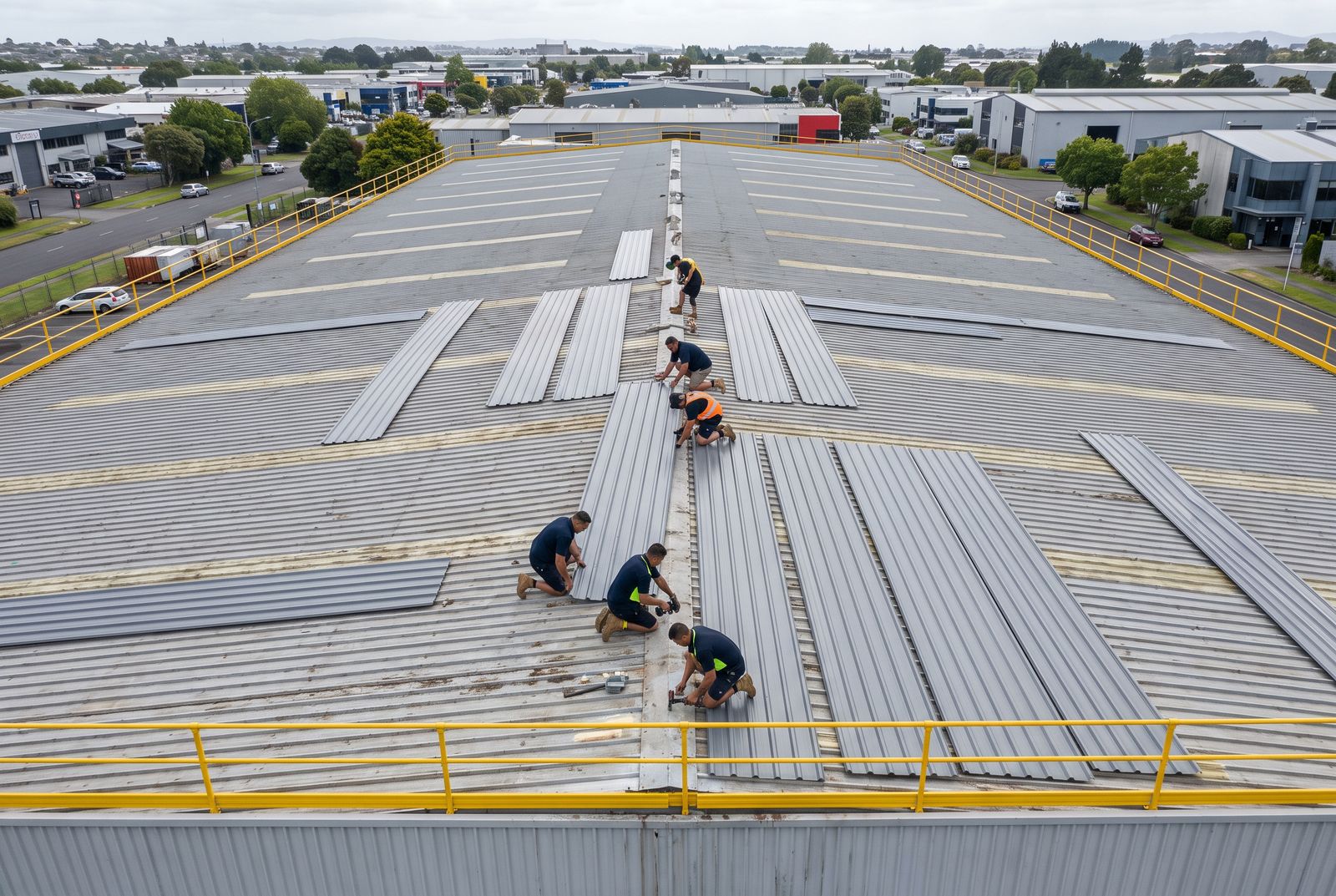
Commercial work runs from reactive repairs to full replacement. For each site we start with a condition inspection and written report, then agree a scope and programme with you. Re-roofs on occupied buildings are staged so only one section is open at a time, with weather contingency and protection for stock and equipment underneath. Where membrane is the right answer for flat areas, our membrane roofing team does those sections on the same programme.
For portfolios and body corporates we set up maintenance programmes: scheduled gutter and outlet clearing, washing of sheltered areas to keep material warranties valid, fixings checks, and a photo report after each visit. Regular condition reports also give you a capital plan, so a re-roof becomes a budgeted project rather than an emergency.
How It Works
Materials, weight and exposure
Large commercial roofs usually use trapezoidal or standing seam profiles, because they carry more water and can be laid at lower pitches. The NZ Metal Roof and Wall Cladding Code of Practice sets minimum pitches by profile, down to 3 degrees for deeper trapezoidal and standing seam profiles, and gives run lengths beyond which the profile's water capacity has to be checked. Long runs also need allowance for thermal movement.
Weight matters in Christchurch. After the 2011 earthquake, a report from New Zealand science and engineering societies recommended replacing heavy roofs such as concrete tiles with lightweight materials such as steel. One example is Rangi Ruru Girls' School, which removed 24 tonnes of heavy clay roofing and replaced it with lightweight pressed metal tiles. Exposure matters too. COLORSTEEL MAXAM is designed for most New Zealand environments, while ALTIMATE is designed for extremely severe marine sites, which can be relevant around Lyttelton's port and the coastal suburbs. Our COLORSTEEL longrun page covers products and profiles in more depth.
Condensation is a particular risk in large steel-framed buildings, and the clear, frosty nights Christchurch gets through winter are the conditions in which it forms. BRANZ research into large-cavity institutional roofs found moisture collecting on steel purlins where a continuous underlay trapped condensation, so the underlay, insulation and ventilation need to be designed together.
Box gutters and drainage
On commercial buildings the gutter often sits inside the building line, so when it overflows the water lands inside. BRANZ recommends designing internal gutters for a higher rainfall intensity than external ones, and good practice includes overflows sized to take the full flow if an outlet blocks. Many older box gutters were never sized for the roof area they now serve, particularly after extensions. We check capacity, outlets and overflows on every commercial inspection, and our spouting service covers replacement and relining. A strong nor'wester can blow leaves and debris into outlets, which is one reason scheduled clearing is worth having on larger sites.
Health and safety, consent and compliance
Working at height on commercial roofs needs proper planning. WorkSafe guidance sets out a hierarchy of controls, with edge protection and scaffolding preferred over harnesses, and edge protection systems designed to AS/NZS 4994. Fragile roofing and translucent sheets need covers or barriers. Every job has a site-specific safety plan, and we coordinate inductions, permits and hazard registers with your facilities team.
Replacing roofing with a comparable material can fall under the Schedule 1 exemption for any building type, as long as the existing roof has met its durability requirement. Changes to structure, materials or drainage may need building consent and, on larger buildings, specific design. Christchurch City Council, Selwyn District Council and Waimakariri District Council each issue building consents and Code Compliance Certificates for their own districts, and heritage buildings in the city have their own rules. Restricted building work rules apply to residential buildings, so multi-unit residential roofs can also need a Licensed Building Practitioner for consented work. We confirm the compliance path before pricing.
Pricing and account work
Commercial projects are priced on a defined scope after an inspection. The main cost drivers are roof area, access and edge protection, the need to work after hours or around operations, removal and disposal, gutter and structural repairs, and the product specification. For ongoing maintenance clients we agree account rates and a schedule. To arrange a site visit, use our contact page.
Why Choose Cheeky's Roofers for Commercial Roofing
Staged around your operations
Re-roofs are sequenced so only one section is open at a time, with stock and people protected below.
Reports that support budgets
Condition reports with photos and ranked recommendations help you plan capital works.
Safety planned, not improvised
A site-specific safety plan, edge protection and coordination with your facilities team on every job.
Maintenance that protects warranties
Scheduled washing and gutter clearing that keep material warranty conditions met.
Account rates
Agreed rates and a single point of contact for portfolio and body corporate clients.
Commercial Roofing FAQs
Can you re-roof while our building is in use?
Yes. We stage the work so only one section is open at a time, plan around the weather and protect the space below. Some tasks may be scheduled outside your business hours.
Do commercial re-roofs need building consent?
Like-for-like replacement can be exempt if the existing roof has met its durability requirement. Changes to structure, material or drainage often need consent from the council for your district. We confirm this before pricing.
Why does our warehouse drip inside when it is not raining?
That is usually condensation forming on the underside of the roofing or purlins on cold nights. The fix is in the underlay, insulation and ventilation, not in sealing the roof.
Do you offer maintenance contracts?
Yes. We set up scheduled inspections, gutter and outlet clearing and washing, with a photo report after each visit and agreed account rates.
What is the lowest pitch a metal roof can be?
The Code of Practice allows some deeper trapezoidal and standing seam profiles down to 3 degrees, depending on run length. Shallower roofs usually need a membrane.
Do you work on body corporate and apartment roofs?
Yes. We work with body corporate committees and managers on inspections, maintenance plans and staged re-roofs, and handle Licensed Building Practitioner requirements where they apply.
Commercial Roofing Across Christchurch
We cover every region: Central Christchurch, North Christchurch, East and Coastal Christchurch, South Christchurch and Port Hills, West Christchurch, Selwyn and Waimakariri.
Related Roofing Services
See the roof replacement cost guide or every service we offer.
Sources and further reading
- NZ Metal Roof and Wall Cladding Code of Practice: roof pitch
- WorkSafe: Working on roofs good practice guidelines
- BRANZ SR289: Remediating condensation problems in large-cavity, steel-framed institutional roofs
- BRANZ: Internal gutters and flow capacity
- COLORSTEEL: product range and environments
- building.govt.nz: Exemption 1.1 general repair, maintenance and replacement
- building.govt.nz: Restricted building work
- NZ Metal Roofing Manufacturers: lightweight roofing recommended after the Canterbury earthquakes
- NZ Metal Roofing Manufacturers: Rangi Ruru Girls' School re-roof
- Christchurch City Council: Plan Change 13 heritage