
Not every roof can take profiled steel. Flat and very low-pitch roofs, decks over living spaces, parapet roofs and internal gutters need a continuous waterproof membrane instead. In Christchurch you find them on flat-roofed extensions behind older houses, on garages and carports, and on newer townhouses with parapets and internal gutters in suburbs such as Sydenham and Merivale.
We lay and repair butynol, TPO, torch-on and liquid-applied membranes across Christchurch, Selwyn and Waimakariri. A membrane only lasts if the fall, substrate and outlets underneath it are right, so that is where every job starts. Where part of a roof can carry steel, our COLORSTEEL and longrun roofing page covers the alternative.
Pricing: every roof gets a free on-site measure and an itemised written quote, with a fixed price agreed before any work starts.
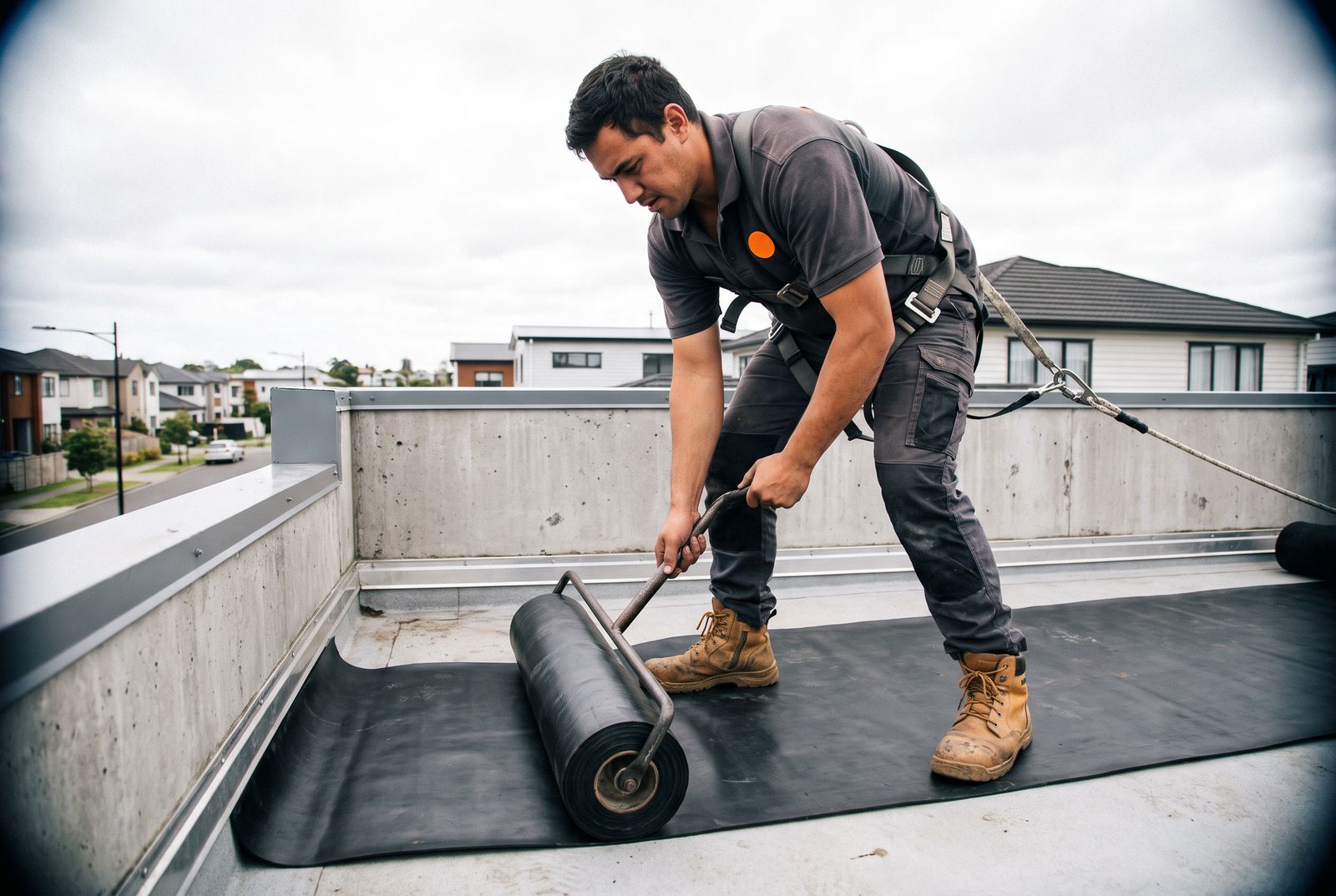
Signs your membrane roof or deck is failing
Membranes rarely fail across the whole surface at once. Trouble starts at seams, outlets, edges and wherever the membrane turns up a wall. Watch for these before they turn into ceiling stains:
- Water still ponding a day after rain, pointing to poor fall or a sagging substrate
- Bubbles, blisters or soft spots underfoot, which can mean trapped moisture
- Lifting or open seams, especially at laps and corners
- Shrinkage pulling the membrane away from upstands and parapets
- Ice sitting on ponded water after a frosty night
- Blocked or undersized outlets with no overflow
- Staining or swelling on soffits, ceilings or framing below
Membrane systems we work with
There is no single best membrane. The choice depends on whether the area is a roof or a deck that people walk on, what it is laid over, how much traffic it takes and how complicated the shape is. Systems used on New Zealand homes are typically covered by a BRANZ Appraisal or CodeMark that sets out where and how they can be used.
Butynol is a synthetic rubber sheet with a long track record on New Zealand roofs and gutters. TPO is a thermoplastic sheet with heat-welded seams. Torch-on is a bitumen membrane, usually in two layers, finished with a mineral cap sheet that stands up to UV and foot traffic. Liquid-applied membranes suit small, awkward areas with many penetrations. We explain the trade-offs for your roof rather than defaulting to one product.
- Butynol: flexible, proven on gutters and smaller roofs, glued and lap-jointed
- TPO: heat-welded seams and light colours, suited to larger flat roofs
- Torch-on: tough two-layer bitumen, common on trafficable decks
- Liquid-applied: seamless coating for small or complex areas
How It Works
Falls, substrate and outlets: where most failures start
Every appraised membrane system specifies a minimum fall. Several published BRANZ Appraisals for TPO and torch-on membranes set 1:30 for roofs and 1:40 for decks on a plywood substrate, with different figures for concrete. If a roof or deck has less fall than its membrane needs, re-covering it with the same product repeats the problem. Correcting the fall means rebuilding the substrate with firring or tapered framing, which we price as its own line.
The substrate matters as much as the membrane. Plywood must be the right grade and thickness, fixed and dry before laying, because moisture sealed under a new membrane causes blistering. Outlets need enough capacity and an overflow, so that a blocked outlet shows itself as water spilling outside rather than into the house. Internal gutters are covered on our spouting page.
Membrane roofs in Christchurch conditions
Christchurch is dry by New Zealand standards, with around 618 mm of rain a year at the airport, but a flat roof is tested by what sits on it rather than the annual total. Around 80 ground frost days a year means any water left ponding on a membrane can freeze overnight and thaw by morning, again and again through winter. That cycle works on seams and on any weakness in the substrate, which is one more reason to get the falls right.
Summer brings the opposite. Te Ara notes that a nor'wester can push Christchurch above 30 C and reach storm force. Hot, dry wind drives thermal movement in the membrane and lifts any edge or capping that is not properly fixed, so edge detailing and cappings are part of our specification. Cold weather also limits when some membranes can be laid, and we follow each manufacturer's installation conditions rather than pushing on through a frost.
What affects the cost of a membrane roof
Membrane work is priced on area, but the details usually decide the total. Your written quote breaks out each item, including:
- Removing the old membrane and any rotten plywood or framing below
- Building up falls where the roof or deck is too flat
- Number of penetrations, outlets, upstands and parapet cappings
- The system chosen and whether the area needs to be trafficable
- Access, scaffolding and protection of the rooms below while the roof is open
Consent and weathertightness
Replacing a membrane with a comparable system in the same position can fall under the Schedule 1 exemption for repair and replacement, as long as the existing roof has met its Building Code durability requirement. A membrane that failed within 15 years, or work that changes the structure, falls or outlets, may need building consent from Christchurch City Council, Selwyn District Council or Waimakariri District Council. On a home, consented work that affects weathertightness is restricted building work and must be done or supervised by a Licensed Building Practitioner.
Decks over living spaces deserve extra care. If your home has an enclosed deck, parapets or internal gutters and a history of unexplained stains, we may recommend a roof inspection first so any hidden damage is known before the quote.
Why Choose Cheeky's Roofers for Membrane Roofing
Falls checked first
We measure the fall before quoting, because no membrane survives water that cannot drain.
Overflows planned
Every outlet we design for has somewhere safe for water to go if it blocks.
Right system, not one system
Butynol, TPO, torch-on or liquid membrane chosen for how the area is used.
Laid in the right conditions
We follow manufacturer limits on temperature and dryness, even when that means waiting for the weather.
Membrane Roofing FAQs
How long does a butynol or membrane roof last?
It depends on the system, UV exposure, foot traffic and maintenance. Each appraised product states its expected durability in its BRANZ Appraisal or product literature. Keeping outlets clear and checking seams yearly makes the biggest difference.
Can you lay a new membrane over the old one?
Sometimes, but only when the existing membrane and substrate are sound and dry and the system manufacturer allows it. Where the substrate is wet or damaged, stripping back is the safer option.
Why does water pond on my flat roof?
Usually the fall is too shallow or the substrate has sagged. Appraised systems specify minimum falls, commonly 1:30 for roofs and 1:40 for decks on plywood. Correcting the fall is part of a lasting fix.
Does frost damage a membrane roof?
Frost on its own is not the main risk. The risk is water that ponds, freezes and thaws repeatedly, working at seams and the substrate. A roof with correct falls drains before it can freeze.
Is butynol or torch-on better for a deck?
Torch-on with a mineral cap sheet is widely used on trafficable decks. Butynol is often chosen for gutters and roofs with little foot traffic. We recommend based on how the area is used.
Can you fix a leak in a membrane without replacing the whole roof?
Yes, if the leak is at a local seam or outlet and the rest is sound. If the membrane is failing widely, patching only delays the cost.
Membrane Roofing Across Christchurch
We cover every region: Central Christchurch, North Christchurch, East and Coastal Christchurch, South Christchurch and Port Hills, West Christchurch, Selwyn and Waimakariri.
Related Roofing Services
See the roof replacement cost guide or every service we offer.
Sources and further reading
- BRANZ Appraisal 792: TPO roofing membrane (minimum falls)
- BRANZ Appraisal 819: membrane roofing and decking (minimum falls)
- Viking Torch-On product technical statement
- ARDEX Butynol BRANZ Appraisal 436
- building.govt.nz: Exemption 1.1 general repair, maintenance and replacement
- building.govt.nz: Restricted building work
- Wikipedia: Christchurch (climate)
- Te Ara: Canterbury region, climate