
Most roof leaks start at a junction rather than in the middle of a sheet. Wherever the roof meets a wall, a chimney, a skylight or another roof plane, a flashing has to carry the water past the gap. When that flashing is short, loose, corroded or sealed with a bead of silicone that has since let go, water finds the way in.
Christchurch roofs have their own set of flashing stories. Thousands of chimneys came down or were cut back after the 2010 and 2011 earthquakes, leaving stubs and patched holes that each need proper flashing. Hot nor'westers drive rain and dust hard against apron and barge flashings. We repair and replace flashings across the city and out to Selwyn and Waimakariri, and where the leak source is unclear we start with roof leak repairs to trace it first.
Pricing: every roof gets a free on-site measure and an itemised written quote, with a fixed price agreed before any work starts.
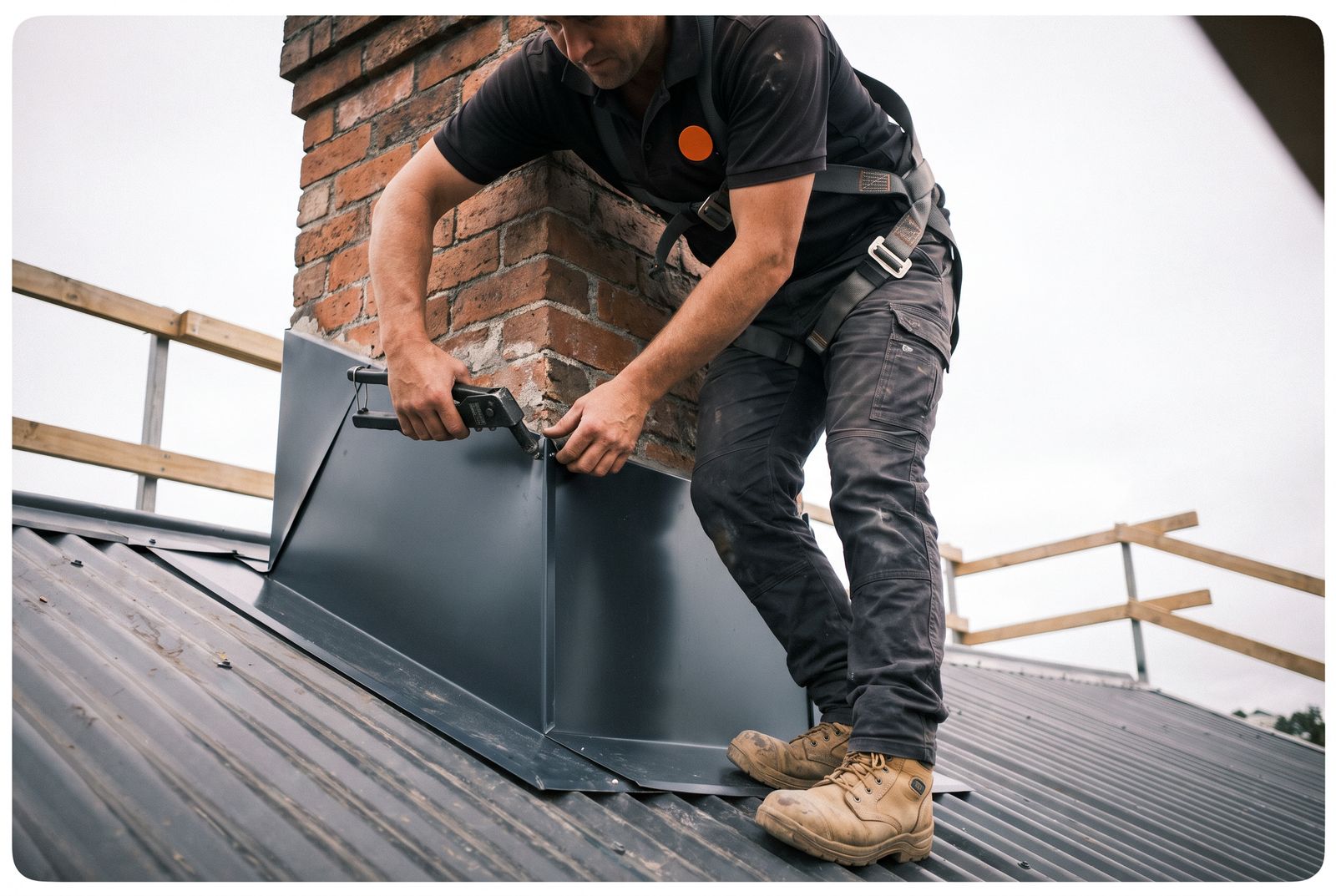
Types of roof flashings
A flashing is a formed piece of steel, or occasionally another material, shaped to fit one particular junction. Each type does a different job, and each fails in its own way.
- Apron flashings, where a lean-to or lower roof meets a wall
- Barge flashings, along the sloping edges of a gable
- Ridge and hip flashings, along the top and the outside corners of a roof
- Valley flashings, carrying water where two roof planes meet
- Chimney flashings, including back gutters on the uphill side
- Penetration flashings, around flues, vents and pipes
- Skylight flashings, usually a kit matched to the roof profile
Why flashings fail
The usual causes are age and corrosion, movement, and poor detailing in the first place. A flashing that is too short, missing its turn-up, or without a proper soaker under the sheet will leak in wind-driven rain no matter how much sealant goes on it. Silicone hardens and cracks with seasonal movement, and a flashing that depends on it is only ever a temporary fix.
Christchurch adds a few local causes. Many roofs were opened up for earthquake repairs, and every flashing refitted then is worth checking if a leak appears. A chimney cut down to below the roofline leaves a patch that is only as good as the flashing over it. Strong nor'westers lift loose flashings and drive rain uphill under short laps. On coastal sites around New Brighton, Southshore and Sumner, sea spray speeds up corrosion, so the steel grade and the fixings matter. Wherever a flashing is in a different metal from the roof, contact between incompatible materials can also corrode one of them.
How It Works
How we repair and replace flashings
First we find which flashing is the problem, from the roof and, where possible, from the roof space. Water often enters some distance from where the stain shows, so we follow it back rather than sealing the nearest join.
Where a flashing is sound but has lifted, we refix it with compatible fasteners and replace failed seals. Where it is corroded, undersized or badly detailed, we fold a new one in matching COLORSTEEL to suit the junction, with correct cover, turn-ups and stop-ends. Chimney stubs often need a new back gutter and apron, or full removal of the stub and a patch of new roofing if the chimney is no longer used.
Need new roof flashing rather than a repair? We supply and install made-to-measure flashings for extensions, new skylights and part re-roofs, folded in steel that matches the existing roof.
Skylight flashings are a common source of slow leaks, especially on older units fitted with homemade flashings. Our skylights page covers replacing these with proper flashing kits.
Chimneys after the earthquakes
The Natural Hazards Commission says removing an unused chimney is the safest option, because the most hazardous part is the section above the roofline. MBIE guidance for the Canterbury rebuild says demolishing a chimney does not need building consent where the building is no more than three storeys and the work does not affect the primary structure, a specified system or fire separation. Once a chimney comes down, the roof over it needs a proper patch and flashing, not a sheet of steel screwed over a hole.
Heritage is the exception. Christchurch City Council's heritage guidance says chimneys on scheduled heritage buildings should be reconstructed where possible, so check the council's heritage schedule before removing one from a listed house.
Flashings and the Building Code
Flashings are part of how a roof meets Building Code clause E2 External Moisture. The NZ Metal Roof and Wall Cladding Code of Practice sets out the detailing that metal roofing should follow, including minimum cover and how flashings meet each profile. We work to it on every flashing we make.
Replacing a flashing like for like is usually exempt from building consent as general repair and maintenance. Larger changes to the roof structure or cladding can need consent from Christchurch City Council, Selwyn District Council or Waimakariri District Council, depending on where you live.
Flashings on a roof near the end of its life
New flashings on an old roof are worth it when the rest of the roof is sound. If the sheets are rusting at the laps, the fixings have failed and several flashings are leaking, a re-roofing quote may be better value, because new flashings come as part of the job. We tell you which way the evidence points and why.
Why Choose Cheeky's Roofers for Roof Flashing
Source found, not guessed
We trace leaks back to the flashing that is failing before quoting a repair.
Folded to fit
New flashings are made to suit the junction in matching steel, not cut from a generic profile and sealed.
Chimney stubs done properly
Removed chimneys get a proper roof patch and flashing, not a screwed-on cover.
Clear photos
You see the failed flashing and the new one, so you know what was done and why.
Roof Flashing FAQs
Can a leaking flashing just be sealed?
Sometimes as a short-term fix, but a flashing that relies on sealant will fail again. If the flashing is too short, corroded or poorly detailed, it needs replacing.
Why does my flashing only leak in a nor'wester or a southerly?
Strong wind pushes rain uphill under short laps and against loose flashings. A flashing that stays dry in still rain can leak when the wind comes from one direction.
What is a back gutter on a chimney?
It is a small gutter on the uphill side of a chimney that diverts water around it. Missing or blocked back gutters are a common cause of leaks around chimneys.
I had my chimney removed after the earthquakes and the ceiling still leaks. Why?
The roof patch or flashing over the old opening may not have been done properly. We check the patch from above and inside and replace it if needed.
Can you match my roof colour?
Yes. We fold flashings in COLORSTEEL to match your roof. Older roofs will have faded, so a new flashing can look slightly brighter at first.
Do flashing repairs need consent?
Usually not. Like for like repair and replacement is generally exempt. We flag it in the quote if your job falls outside the exemption.
Roof Flashing Across Christchurch
We cover every region: Central Christchurch, North Christchurch, East and Coastal Christchurch, South Christchurch and Port Hills, West Christchurch, Selwyn and Waimakariri.
Related Roofing Services
Roof Flashing Guides
- Earthquake-Repaired Roofs in Christchurch: What to Check Before You Buy
- Roofing Near the Beach: New Brighton, Southshore and Sumner
- Removing an Old Wood Burner Flue: Patching the Roof After Clean Air Changes
- Removing a Chimney in Christchurch: Consent, Roof Patching and Safety
See the roof replacement cost guide or every service we offer.
Sources and further reading
- NZ Metal Roof and Wall Cladding Code of Practice
- MBIE building.govt.nz: E2 External Moisture
- MBIE building.govt.nz: Exemption 1, general repair, maintenance and replacement
- MBIE building.govt.nz: Canterbury residential guidance update issue 5 (chimney demolition)
- Natural Hazards Commission: Chimneys remain common hazards on NZ homes
- Christchurch City Council: Heritage guideline 3, chimneys
- Te Ara: Canterbury region, climate