Lightweight steel has a particular case in Christchurch. After the 2011 earthquake, a report from New Zealand science and engineering societies recommended replacing heavy roofs such as concrete tiles with lightweight materials such as steel, and the Natural Hazards Commission's QuakeSafeHome guidance still points the same way.
We install COLORSTEEL longrun roofing on re-roofs, tile to steel conversions, extensions and new builds across the city and in Selwyn and Waimakariri. Each roof is measured on site, the profile is matched to the pitch, and the steel product is matched to how close you are to the sea. If you are replacing an existing roof, start with our re-roofing page.
Pricing: every roof gets a free on-site measure and an itemised written quote, with a fixed price agreed before any work starts.
What a longrun roof is made of
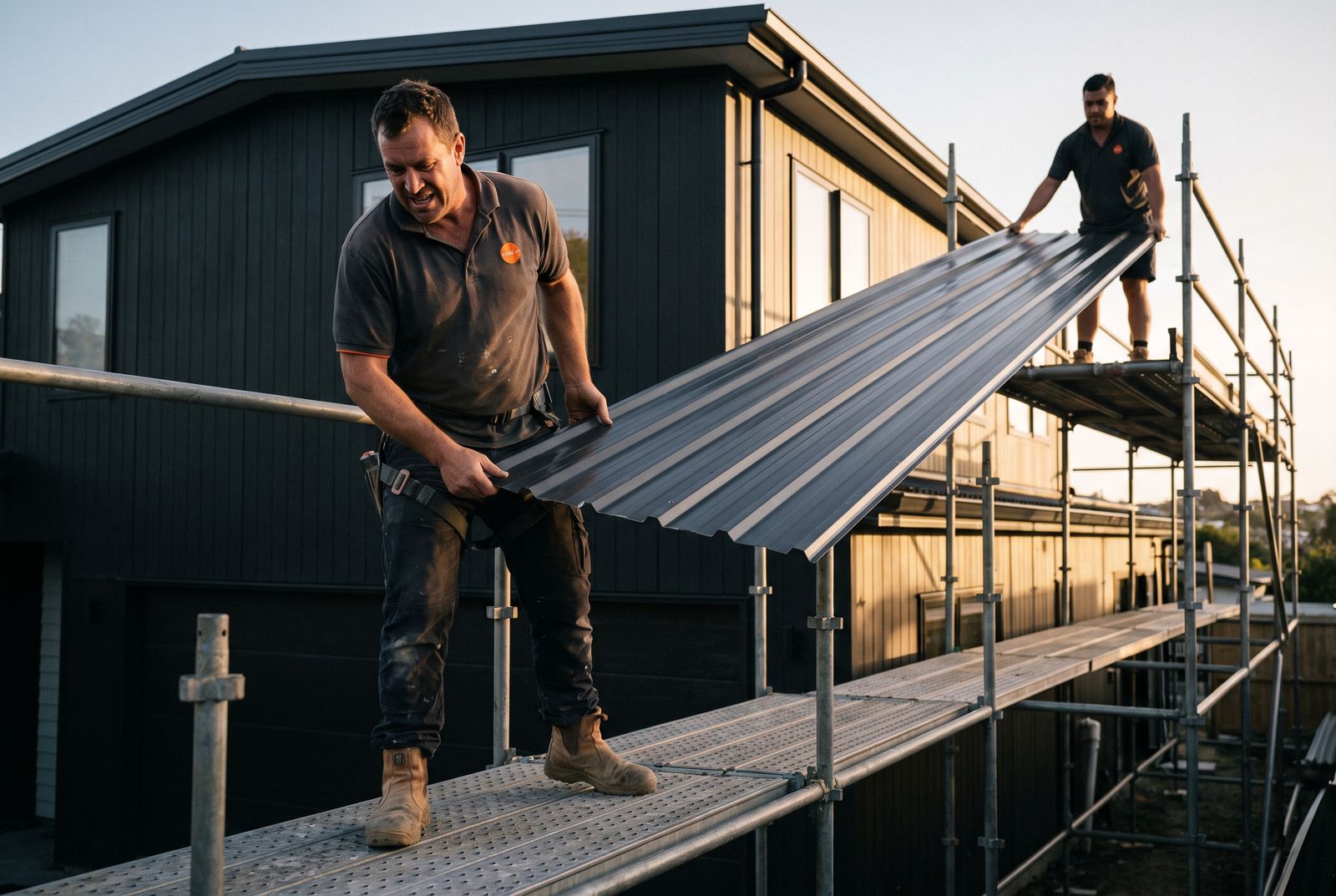
A longrun roof is a set of steel sheets roll-formed to the full length of each roof plane, so most runs have no end laps for water to track back through. The sheets are fixed to purlins or battens over a roofing underlay, with ridging, barges, aprons and valleys folded from matching steel to close every edge and junction.
COLORSTEEL is the pre-painted steel brand made in New Zealand, and its current range is built around two products. COLORSTEEL MAXAM is designed for most New Zealand environments, from inland suburbs to many coastal sites. COLORSTEEL ALTIMATE is designed for extremely severe marine and breaking surf environments. COLORSTEEL rates sites on a five-step scale from Mild to Extremely Severe and asks that any site within 100 metres of salt water be confirmed with them before the product is chosen.
- Corrugate: the classic wave profile, at home on bungalows and most pitched roofs
- Trapezoidal: taller, squarer ribs that carry more water and suit lower pitches and longer runs
- Underlay: a layer under the steel that manages condensation and wind-driven moisture
- Flashings and ridging: folded steel sealing the ridge, edges, walls and penetrations
Choosing a profile: pitch and run length come first
Every profile has a minimum pitch, and longer runs need more water-carrying capacity. The NZ Metal Roof and Wall Cladding Code of Practice sets these out. For standard 16.5 mm corrugate the minimum cladding pitch is 8 degrees, while deeper trapezoidal profiles can go down to 3 or 4 degrees depending on rib height.
So a low-pitch extension or a long skillion roof often needs a trapezoidal profile even when the rest of the house is corrugate. We measure the actual pitch on site rather than trusting the drawings, because older homes and repaired homes rarely match their plans exactly. Where part of a roof is too flat for any profiled steel, a membrane roofing system is usually the answer for that section.
How It Works
Coastal east or inland plains: picking the steel
Distance from the sea and exposure decide which COLORSTEEL product suits your roof. Homes close to the beach at New Brighton, Southshore and Sumner, or facing the harbour at Lyttelton, take more salt than a house in Riccarton, Rolleston or Rangiora, and wind can carry that salt further inland than you might expect. COLORSTEEL publishes distance bands and environment categories, and BRANZ Maps lets you look up the NZS 3604 corrosion zone for a particular address. We check your address before recommending a product rather than assuming from the suburb name.
Exposure also changes the maintenance that keeps the warranty valid. Rain washes most of an open roof, but sheltered areas under eaves and around walls need manual washing more often as exposure rises. We tell you what your site needs before you sign. Our roof cleaning page explains how that washing is done safely.
Nor'westers, frost and fixings
Te Ara describes the Canterbury nor'wester as a hot, dry wind that can reach storm force and cause widespread minor damage. On a steel roof, the edges, ridges and barges take the brunt. We fix sheets at the spacings the Code of Practice and the manufacturer require for the site, use the correct fastener for the steel and the exposure, and make sure barges and ridging are fixed down rather than relying on laps alone.
Winter brings a different test. Christchurch averages around 80 ground frost days a year, and on cold clear nights a steel roof drops below the air temperature, so moisture from the house can condense on its underside. The right underlay, laid with proper support and laps, is the first defence. Our roof ventilation page covers the rest.
What affects the price of a longrun roof
We do not publish a per square metre rate, because two roofs over the same floor area can cost very different amounts. Your written quote is itemised so you can see where the money goes. The main drivers are:
- Roof area measured on the slope, not the house footprint
- Pitch and complexity: hips, valleys, dormers and multiple levels add flashings and labour
- Steel product and profile chosen for your site's exposure
- Access and scaffolding, especially on two-storey or hillside sections in the Port Hills
- Removing and disposing of the old roof, including heavy concrete tiles on a tile to steel job
- New purlins or battens where a tile roof's batten spacing does not suit steel
Consent and the Building Code
Replacing a roof with a comparable material in the same position is often exempt from building consent under Schedule 1 of the Building Act, provided the old roof has met its Building Code durability requirement. Roof cladding sits in the 15-year durability category, so a roof that failed early, or a change of structure or material, can mean consent is needed. Where consent is required for a home, roofing that affects weathertightness is restricted building work and must be carried out or supervised by a Licensed Building Practitioner.
In Christchurch the building consent authority is Christchurch City Council; in Selwyn and Waimakariri it is the district council. Heritage-listed houses and those in a Residential Heritage Area may also need planning advice before the roof material changes. We confirm which path applies before quoting, and our roofing FAQs cover the common scenarios.
Why Choose Cheeky's Roofers for Metal Roofing
Steel chosen for your address
We check your site's exposure before recommending MAXAM or ALTIMATE, rather than assuming from the suburb.
Pitch measured, not assumed
Profiles are matched to the measured pitch and run length, so water is carried off every plane.
Fixed for the nor'wester
Sheets, ridging and barges are fixed to the spacings the site calls for, with the right fasteners.
Itemised quotes
You see area, profile, product, flashings, access and disposal as separate lines.
Metal Roofing FAQs
How long does a COLORSTEEL roof last?
It depends on the product, the site's exposure and maintenance. COLORSTEEL publishes warranties by environment category, and the Building Code requires roof cladding to last at least 15 years. We explain the warranty for your site in the quote.
Is corrugate or trapezoidal better?
Neither is better everywhere. Corrugate suits most pitched roofs and traditional homes. Trapezoidal carries more water, so it suits lower pitches and long runs. The minimum pitch for each profile is in the NZ Metal Roof and Wall Cladding Code of Practice.
I live near the beach in New Brighton or Sumner. Which COLORSTEEL do I need?
COLORSTEEL MAXAM covers most environments, and ALTIMATE is designed for extremely severe marine and breaking surf sites. Anything within 100 metres of salt water should be confirmed with COLORSTEEL, which we do as part of the quote.
Can you replace my concrete tile roof with COLORSTEEL?
Yes. Tile to steel is a common Christchurch re-roof and takes a lot of weight off the house. The batten layout usually needs changing for steel, and we include that in the quote.
Will a steel roof be noisy in the rain?
A properly fixed roof over underlay and ceiling insulation is not noticeably loud inside most homes. Rattles usually come from loose fixings or worn washers.
Can you match an existing roof colour on an extension?
We can match the colour name, but new steel will look brighter than a roof that has weathered for years. We show you samples against the existing roof so you can decide.
Metal Roofing Across Christchurch
We cover every region: Central Christchurch, North Christchurch, East and Coastal Christchurch, South Christchurch and Port Hills, West Christchurch, Selwyn and Waimakariri.
Related Roofing Services
Metal Roofing Guides
- Choosing a COLORSTEEL Colour for a Christchurch Roof: Heat, Frost and Covenants
- Roofing Near the Beach: New Brighton, Southshore and Sumner
See the roof replacement cost guide or every service we offer.
Sources and further reading
- COLORSTEEL: product range and environments
- COLORSTEEL: warranty and maintenance
- NZ Metal Roof and Wall Cladding Code of Practice: roof pitch
- building.govt.nz: Exemption 1.1 general repair, maintenance and replacement
- building.govt.nz: Restricted building work
- BRANZ Maps: corrosion and wind zones
- Natural Hazards Commission Toka Tū Ake: QuakeSafeHome
- Te Ara: Canterbury region, climate
- Christchurch City Council: coastal hazard assessment