

Blocked spouting is one of the most common causes of water getting where it should not: overflowing into soffits, staining cladding and soaking the ground beside the foundations. Gutter guards promise to stop that, and for many houses they do. The catch is that the wrong guard, or a good one fixed badly, can create new problems.
This guide covers which guard types work, which suit big trees, how they behave in snow, frost and wind, and how much cleaning you still need to do.
Do gutter guards actually work?
Gutter guards work by letting water through while holding leaves, twigs and seed pods on top, where wind and rain can move them on. They cut blockages a lot, but fine debris, moss and roof grit still get through and settle in the spouting over time.
How well a guard works depends on three things: the size of the holes against the debris your trees drop, how well it is fixed at the roof edge, and whether the spouting underneath is in good condition. A guard on top of sagging, leaking or undersized spouting just hides the real problem. If your spouting overflows in heavy rain even when clean, the fix is new spouting or more downpipes, not a guard.
Which type of gutter guard is best?
For most Christchurch homes a metal mesh guard that is fixed under the roofing at the top and to the spouting at the front is the best all-rounder. Plastic clip-on guards and inserts cost less to fit but are easier to lift, crack or clog.
The table compares the common types in plain terms. We do not list prices here because the cost depends on the length of spouting, roof access and the guard chosen, and we quote it after a measure.
| Type | How it works | Good for | Watch for |
|---|---|---|---|
| Metal mesh (steel or aluminium) | Fine mesh over the spouting, fixed under the roof edge | Most leaves, needles and seed pods | Must suit the roofing material and be fixed well |
| PVC or plastic clip-on | Plastic grille clipped to the spouting | Large leaves on sheltered houses | Sun and frost make some plastics brittle; can lift in wind |
| Brush inserts | Bristles sit inside the spouting | Easy fitting on short runs | Debris tangles in the bristles; needs lifting out to clean |
| Foam inserts | Porous foam fills the spouting | Short runs with light debris | Fine debris and moss clog the foam over time |
Which gutter guard suits big trees in Fendalton or Riccarton?
Under big trees, choose a fine metal mesh fixed under the roofing, because it stops small leaves and seed pods that slip through coarser plastic grilles. Mature trees in Riccarton and the older western streets drop leaves into spouting and valleys through autumn and winter, so the guard has a lot of work to do.
Pay attention to the valleys as well as the spouting. A valley gutter between two roof planes collects leaves before they reach the spouting, and a guard on the spouting does nothing there. On an older house with big trees close by, whether it is in Fendalton, Riccarton or anywhere else, a choked valley can push water back under the roofing long before the spouting overflows.
Needles from conifers are the hardest test, because they spear through coarse openings and knit together. If your section has pines or similar trees, ask to see the mesh size before you agree to a product. Our page for roofers in West Christchurch covers the other things we look at on these properties, including frost under steel roofs.
Spouting always full of leaves?
We will check your spouting, downpipes and fascia, and tell you whether guards, cleaning or new spouting is the right fix.
Do gutter guards cope with snow and ice?
Well-fixed metal mesh copes with snow, but snow sliding off a steel roof can bend or tear guards and spouting that are poorly supported. Snow falls in Christchurch on average about three times a year, with some years having none, so it is not constant, but it does happen.
Snow straps on spouting are normal in snow-prone areas and help stop the weight of sliding snow folding the spouting outwards. Frost is the more regular test. Christchurch averages about 80 ground frost days a year, and water sitting in a clogged mesh can freeze and hold more weight. A guard that sheds debris keeps the spouting draining, so there is less water left to freeze. For more on snow and roofs, read our guide to snow on Canterbury roofs.
Can gutter guards blow off in a nor'wester?
Yes, loosely clipped guards can lift and blow off in a strong nor'wester, which is why the fixing matters more than the product name. Te Ara describes the nor'wester as a hot, dry wind that can reach storm force and cause widespread minor property damage.
A guard that tucks under the edge of the roofing and is screwed along the front of the spouting resists wind far better than one held by plastic clips alone. On exposed sites, including hill properties on the Port Hills where trees overhang and wind is funnelled, we look at the fixing spacing as well as the material.
Fitting a guard must not damage the roof itself. The mesh should sit under the sheet edge without lifting it, and it must be a material that is compatible with your roofing and spouting so it does not cause corrosion where they touch.
- Fixed under the roof edge rather than resting on top of it
- Screwed or riveted along the front of the spouting
- Joins lapped in the direction of the wind and water
- End caps and corners closed so wind cannot get under the mesh
Do gutters still need cleaning with guards fitted?
Yes. Guards reduce how often spouting needs clearing, but fine debris still collects inside, and leaves build up on top of the mesh where the roof is sheltered from wind. Plan on a check at least once a year, and after autumn leaf fall if trees overhang the house.
Cleaning with guards fitted is a different job. Some debris can be brushed off the top, but the spouting underneath still needs flushing, and the downpipes need checking for blockages at the outlets. If you would rather not be on a ladder, our gutter cleaning service clears the spouting and downpipes by hand and sends before and after photos.
Coastal homes have one more reason to keep at it. COLORSTEEL expects areas the rain does not wash, such as spouting undersides, to be washed by hand in coastal environments to keep the warranty valid, and a guard does not change that.
When should you call a roofer about gutter guards?
Call a roofer before fitting guards if your spouting overflows when clean, sags between brackets, leaks at the joins, or if guards need to go under the roof edge on a steep or two-storey house. Cheeky's Roofers checks the spouting, downpipes and fascia first, then recommends a guard only if the spouting is worth guarding.
If the spouting is near the end of its life, new spouting with guards fitted at the same time is often the tidier answer, and rotten boards can be replaced through our downpipes and fascia service. Where moss and lichen on the roof are washing into the spouting, a roof cleaning and moss treatment reduces what reaches the guards in the first place.
Summary
Gutter guards work in Christchurch when they suit the trees on your section and are fixed to handle snow and the nor'wester. Metal mesh fixed under the roof edge is the best fit for most homes, but you still need a yearly check. Book a free measure and Cheeky's Roofers will look at your spouting and give you a written quote.
Frequently Asked Questions
Can I fit gutter guards myself?
Clip-on guards on a single-storey house are a common DIY job. Guards that tuck under the roof edge mean working at the edge of the roof, which is a height risk WorkSafe takes seriously. On two-storey houses or steep roofs, use a roofer with the right edge protection.
Do gutter guards stop birds nesting in spouting?
A well-fitted mesh guard with closed ends usually stops birds getting into the spouting itself. It does not stop them nesting under the roofing at the eaves, which needs separate bird stops or closures at the sheet ends.
Will gutter guards work on a tile roof?
Yes, but fitting is different. On tiles, the mesh is usually fixed under the bottom row of tiles or to the spouting only, and care is needed not to crack tiles or lift them. Mesh shaped for tile roofs is available.
Do guards help if I collect rainwater in a tank?
They help by keeping leaves out of the spouting and downpipes that feed the tank, but they are not a filter. You still need a leaf diverter or first flush device and a tank screen if the water is used in the house.
How long do gutter guards last?
Metal mesh generally lasts much longer than plastic, which can become brittle with sun and frost. The fixing and the condition of the spouting underneath usually decide how long the system lasts, so check both when you get your yearly clean.
Our Services
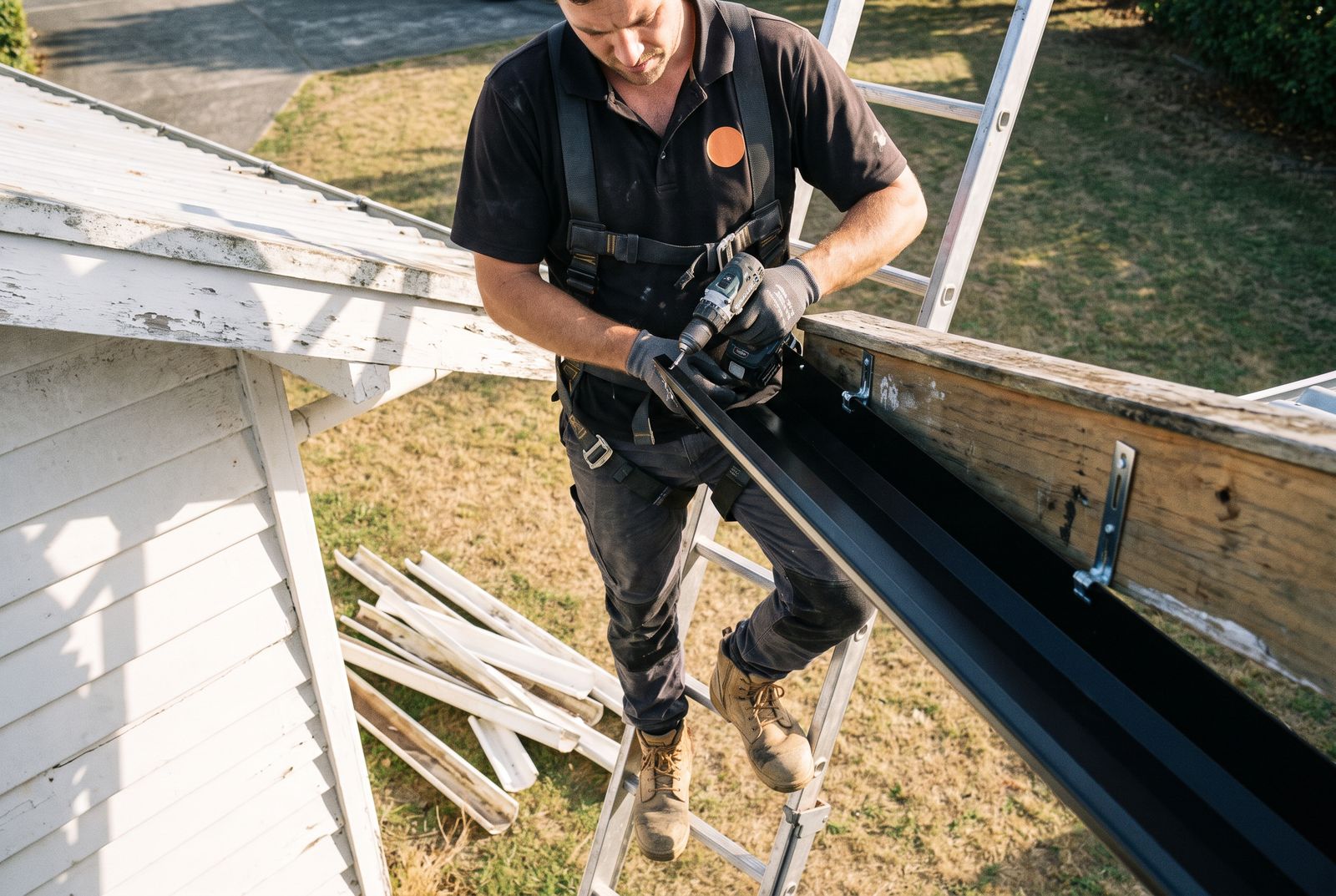 Spouting and GuttersNew spouting, gutter replacement and repairs in steel and PVC, sized to carry heavy downpours.
 Downpipes and FasciaDownpipes and fascia replaced or repaired, often alongside new spouting or a re-roof.
 Roof WashingMoss, lichen and grime removed with the right treatment for your roof type, without damaging the surface.
Read Next

Snow on Canterbury Roofs: Snow Load Zones, Spouting and When to Worry
New Zealand roofs are designed for a snow load set by the site's snow zone and altitude under the loadings standard and ...
Read article
Nor'wester Roof Damage: What to Check After a Canterbury Windstorm
After a strong nor'wester, check from the ground for lifted or missing roofing sheets, loose ridging and barge flashings...
Read article
Choosing a COLORSTEEL Colour for a Christchurch Roof: Heat, Frost and Covenants
The best COLORSTEEL colour for a Christchurch roof is one that suits the house, passes any covenant or heritage check, a...
Read article